


Adapt Your Leadership Style to Increase Employee Performance
Leading within an organization can be challenging. Effective leadership requires striking the right balance between understanding the tasks to be completed, the results expected from the team, and their level of maturity on the job. No single leadership style works universally, as workplace factors and individual personality traits significantly impact decision-making.
A management leadership style should not be static—it must evolve alongside each employee’s development and skill level.
To address this, Hersey & Blanchard (1977) developed the Situational Leadership Model, which adapts leadership approaches based on an individual’s competence and commitment in the workplace,as shown below, based on an individual’s approach to tasks and relationship within the workplace:
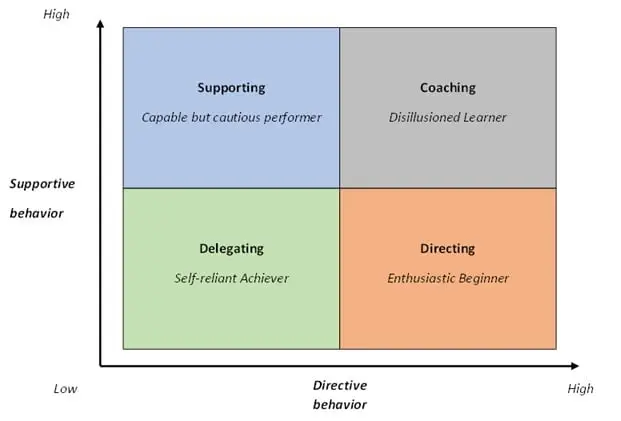
(Hersey-Blanchard, 1977)
- Directing
The directing leadership style is best suited for “enthusiastic beginners”—employees with low competence but high commitment to learning and task execution.
Managers using this style should:
- Provide clear and explicit guidelines
- Closely supervise the employee’s work
- Focus primarily on task completion
- Coaching
The coaching leadership style is ideal for “disillusioned learners”—individuals who start off eager but lose confidence because their skills are not yet sufficient for the job.
These employees:
- Have some technical ability but lack confidence
- Struggle with low commitment due to past failures
Managers should:
- Focus on building confidence
- Offer support and motivation
- Encourage open dialogue to help them regain enthusiasm
3. Supporting
The supporting (or participating) leadership style emphasizes collaboration and communication. It is ideal for “capable but cautious performers”—employees who have the necessary skills but need reassurance.
These employees:
- Are competent but may hesitate to take initiative
- Need encouragement to boost confidence
Managers should:
- Share decision-making responsibilities
- Provide positive reinforcement
- Maintain a high level of interaction
4. Delegating
The delegating leadership style is a hands-off approach suitable for “self-reliant achievers”—employees with strong competence and commitment.
These employees:
- Are highly skilled and self-motivated
- Require minimal supervision
Managers should:
- Offer autonomy while remaining available for support
- Trust the employee’s decision-making abilities
- Intervene only when necessary